The Arrivals: The Foundations of the Antichrist — Hollywood’s War on the Arab World
Includes videoWhat else has Hollywood mastered? Soft humor. Making people laugh at a group of people until the disrespect becomes normal. And nobody has been put through this machine more than the Arabs.
In Reel Bad Arabs, media scholar Jack Shaheen examined more than 1,000 films and exposed a pattern that had been going on for over a century. Arabs were portrayed as subhuman, terrorists, religious fanatics, greedy oil billionaires, and straight-up clowns. Shaheen compared some of these portrayals to the Nazi term Untermensch, used to describe people as inferior.
Think about that. Generations of Americans have grown up watching the same people portrayed as the bad guys. The Arab is the terrorist. The Muslim is the threat. The Middle East is dangerous. And America is always the hero.
Even when Arabs appear in comedies, they're often there to make people laugh at them. When people see the same images over and over, they stop questioning them. The programming becomes invisible.
That's how you manipulate public perception without ever giving a political speech. You make propaganda entertaining.
From Hollywood to the Middle East
Now connect that programming to real life.
When Americans are constantly shown Arabs as dangerous, how difficult is it to convince them that war against Arab countries is necessary? How difficult is it to make people ignore dead civilians, destroyed neighborhoods, and families being forced from their homes?
Look at what happened after September 11, 2001. The War on Terror became the justification for invasions, military operations, surveillance, and years of conflict. Iraq was invaded in 2003. Meanwhile, Hollywood and television continued feeding the public images of Arabs and Muslims as threats.
Who benefits when the American public is trained to fear the people living in the very region where powerful governments have strategic interests?
That's the question people need to start asking.
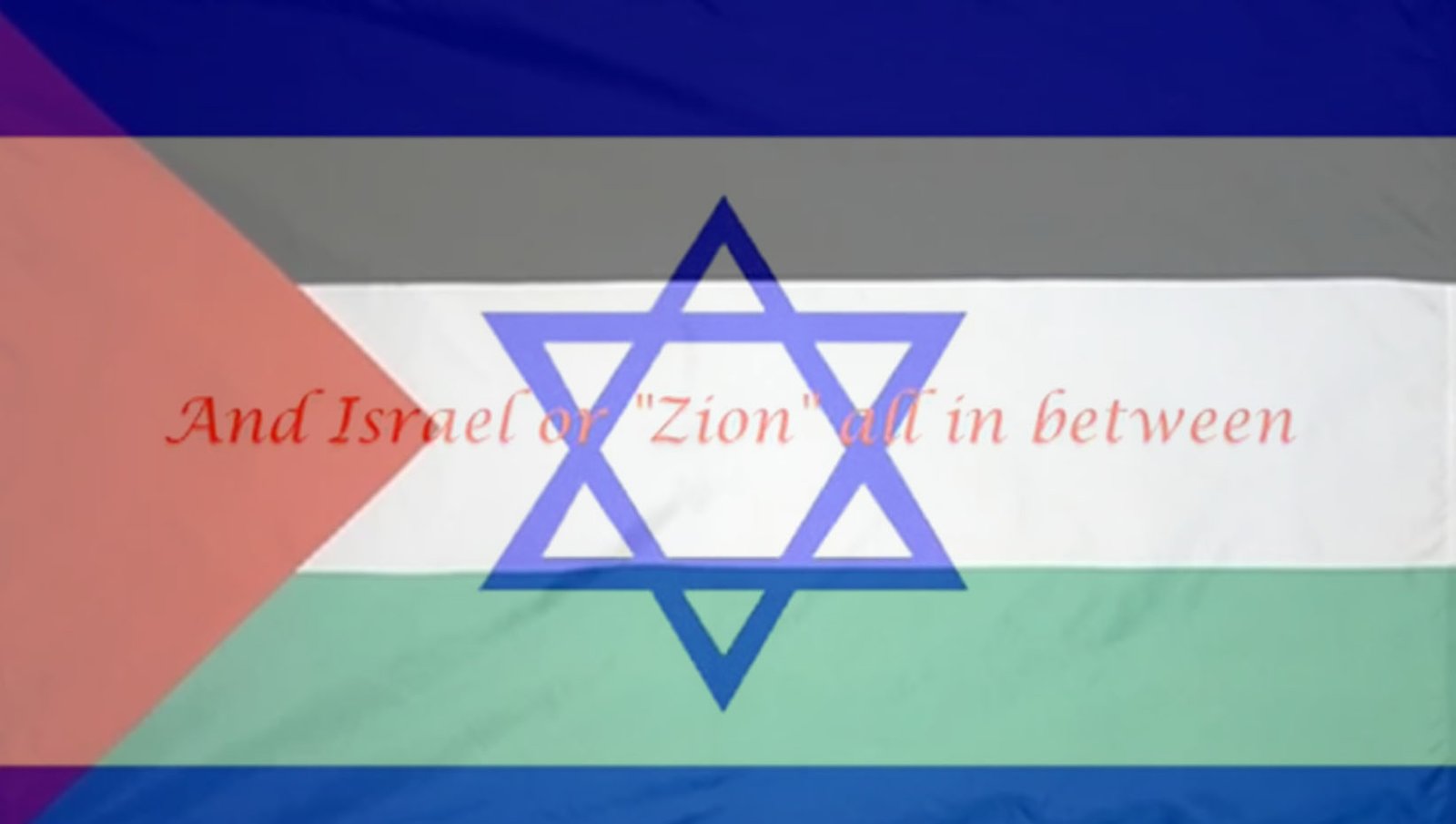
Zionism and the Media: Biblical Israel vs. the Modern State of Israel
Zionism is a political movement connected to establishing and supporting a Jewish homeland in Palestine, where the modern State of Israel was established in 1948. But political movements aren't above criticism, and neither are the governments, organizations, donors, media figures, and lobbyists that support them.
Here's what people need to understand: the Israel spoken of in scripture and the modern State of Israel are not the same thing.
In the Torah and the Old Testament, Jacob was given the name Israel, and his descendants became known as the Children of Israel. The Quran also refers to them as Bani Isra'il, while the Book of Enoch contains its own ancient religious and prophetic traditions.
Jacob, his descendants, and the modern political state are distinct concepts. Sharing a name does not make a modern government identical to the biblical people or automatically grant it divine authority.
Now look at how powerful that name is.
When people hear “Israel,” they may immediately think of Jacob, the biblical Israelites, God's promises, and sacred scripture. Connecting a modern state to that name can create a powerful religious association in the public mind. Political leaders can draw on that association to gain support, discourage criticism, and make political decisions appear connected to biblical promises.
This is where the manipulation comes in.
Within The Arrivals, the argument is that using the name Israel serves a larger agenda: blurring the line between biblical identity and modern political power, making it harder for ordinary people to separate scripture from political messaging. The concern is that this confusion can be used to advance a political agenda under the appearance of divine authority—and, within the series' prophetic framework, connect to the coming of the Antichrist.
Revelation 2:9 and 3:9 use the phrase “synagogue of Satan” in warnings about specific communities. Within the interpretation explored in The Arrivals, these passages connect to the broader warning about deception, false claims of spiritual authority, and the Antichrist.
The issue isn't just a name. It's how scripture, symbolism, and political identity can be used to shape what people believe—and whether they recognize deception when it comes dressed in religious language.
Do not confuse Jacob with a modern government. Do not confuse biblical promises with political decisions. And do not let anyone use a sacred name to place a government beyond criticism.
Who Controls the Narrative?
The problem becomes even more serious when political interests influence how the public sees the conflict.
When Israel bombs Gaza, are Americans shown the full human cost? When Palestinians are displaced, do their stories receive the same attention as Israeli government statements? When someone criticizes Israeli policy, why does the discussion so often shift away from the actual policy and toward accusations against the person asking questions?
Follow the messaging. Follow the money. Look at who gets heard, who gets ignored, and who benefits.
This isn't just about movies. It's about conditioning people to accept a particular version of history and politics before they've even investigated the facts for themselves.
The Promised Land: From the Nile to the Euphrates
Genesis 15:18 describes a land promise extending from the river of Egypt to the Euphrates. This passage has become part of modern discussions about the idea of a Greater Israel.
The question is what happens when ancient religious claims become connected to modern territorial ambitions.
Who supports expansion? What do political leaders say about Palestinian land? What do their policies accomplish? And what happens to the people already living in those territories?
You don't need to look away from the evidence to ask these questions.
If powerful political and religious movements envision a different Middle East, the people who live there have every right to know what that vision means for their future.
[IMAGE: Map of the Middle East showing the Nile and Euphrates rivers.]
Look at the Middle East Since 1948
- Egypt: Signed a peace treaty with Israel in 1979.
- Jordan: Signed a peace treaty with Israel in 1994.
- Saudi Arabia: Maintains a major strategic relationship with the United States, including security and defense ties.
- Palestine: Has endured decades of displacement, occupation, and repeated wars.
- Iraq: The United States invaded in 2003 during the War on Terror.
- Syria and Iran: Have remained opponents of key Israeli regional objectives and have faced years of conflict with Israel and the United States.
Now look at the bigger picture. Governments make deals. Military alliances shift. Leaders depend on powerful partners. Wars change the balance of power. And ordinary people often pay the price.
Ask yourself whether the public has been given the full story about these relationships—or only the version that serves the interests of those in power.
The Protocols of the Elders of Zion
The passages in my notes attributed to The Protocols of the Elders of Zion discuss secret societies, political manipulation, economic control, and the pursuit of power. These are serious claims that deserve to be examined against historical documents and evidence.
The larger question is whether powerful people and institutions use secrecy, propaganda, financial influence, and political pressure to shape world events.
Look at the institutions themselves. Examine their records, their relationships, their public statements, and their actions. Don't let any newspaper, government, or media company tell you that a subject is off-limits simply because it's uncomfortable.
Freemasonry, political Zionism, and the Israeli government are distinct, and specific connections must be examined through evidence. But no institution should be immune from investigation.
War or Consensus
A regional order can be created through war. It can also be created through political agreements and alliances.
A leader who depends on a powerful ally for money, weapons, or political protection may face enormous pressure to follow that ally's interests.
That's why we need to look at the deals governments make, the promises they exchange, and the consequences for the people who have no seat at the negotiating table.
Who benefits from these arrangements? Who loses their land? Who loses their family? Who gets to decide what the future of the Middle East will look like?
These are not questions that should be answered by Hollywood scripts or government talking points.
The Royal Bloodline and the Throne of David
The movie excerpt in my notes describes a royal family claiming a bloodline connected to Thor, Alexander the Great, Abraham, Muhammad, David, and Jesus. It then connects that lineage to the throne of David and the kingdom of the Lord over Israel.
Why do royal families emphasize ancient bloodlines? Because ancestry can be used to claim legitimacy, authority, and even divine favor.
In The Arrivals, these symbols connect to the larger question of how ancient religious stories and claims of inheritance are used to influence the modern world.
The Spell Is Breaking
For more than a century, Hollywood has helped shape how people see Arabs. For decades, political messaging has influenced how Americans understand the Middle East. And for years, people have been told which questions are acceptable and which ones they shouldn't ask.
But people are watching the footage. They're reading documents. They're comparing official statements with what is happening on the ground. They're questioning the stories they grew up believing.
On November 21, 2024, the International Criminal Court issued arrest warrants for Benjamin Netanyahu and Yoav Gallant over alleged war crimes and crimes against humanity connected to Gaza. These are serious legal proceedings, not merely accusations made on social media.
The public has every reason to investigate the conduct of governments and the interests behind their policies.
The more people learn to question the images, the symbols, and the narratives placed in front of them, the harder it becomes to control what they believe.
Watch the material. Do your own research. Figure it out for yourself. You're smart enough to decide what it means.